

Eid al-Adha, the Festival of the Sacrifice, is an important Muslim holiday that commemorates God’s test of Ibrahim’s faith with his son Ishmael. The day marks the end of the Hajj, the Muslim religious pilgrimage.
The holiday celebration is traditionally shared with non-Muslims to increase understanding of Muslim culture. Similar traditions (stories of Abraham and Isaac) are celebrated in Judaism and Christianity. How cool is that?
Eid al-Adha 2022
The date of Eid al-Adha changes each year because the Muslim calendar is a lunar calendar. The date is also based on the sighting of the moon so dates may vary by location. The next celebration is Saturday-Wednesday, July 9-13, 2022.
Eid al-Adha 2020
We celebrate Eid al-Adha 2020 from Thursday-Monday, July 30 to August 3, 2020 from sundown to sundown.
Since celebrations of faith are communal gatherings, it’s been a hard year for everyone. The COVID-19 epidemic prevented many Muslims from the traditional celebrations of Ramadan.
A New York City Holiday
Eid al-Adha is an official New York City school holiday.
The Story of Eid al-Adha
God told Ibrahim to sacrifice his son. The devil tempted Ibrahim to ignore God’s command, but Ibrahim chased the devil away by throwing stones at him.
When Ibrahim prepared to do as he had been told, God switched his son for a ram. Ibrahim had passed the test of putting his love of God above all else.
The moral of the story is that we should trust God even with the things that are most dear to us, and be willing to make tremendous sacrifices for our faith. People of faith, all faiths, know this to be true.
[Thank you to the reader who helped correct our previous mistaken interpretation of this important story.]
Many Faiths Share Abrahamic Roots
The story of Eid al-Adha is known in Judaism as the Akedah, the binding of Isaac. It is in the Tora, the first book of Moses (Genesis, Ch. 22).
The same story is in the Christian Old Testament.
The point is that Judaism, Christianity and Islam all share the same story. We have the same roots.
Islam is a major religion of Africa from the time of Arab coastal traders, before the Europeans. So there are many African Muslims, especially across the Sahara in North Africa.
In the Caribbean, we have met people who speak some Arabic because they were taught to pray at home. Dutty Boukman, an early leader of the Haitian Revolution was named “Boukman” because he was a man of the book. He was a Muslim priest.
In U.S. schools we are taught that Roman and Italian Renaissance civilizations are the roots of Latin culture and Western European culture. However, recently we realized and have found confirmation in the literature that there was a third great civilization.
It was Islamic Al-Andalus in Spain. Al-Andalus was the height of Islamic culture and one of the most scientifically advanced cultures of its time. A lot of civilization had been lost when Rome collapsed, but Jewish poets who wrote in Arabic for Spanish sultans recovered classical Greek ideas from the great libraries of Islam. We are also the heirs of a lot of basic science done in this time. A surprising amount of European culture actually originates in the Arab world and points further east. Even the beloved pandereta drum of Puerto Rican Plena music was originally an Arab drum.
The Blues, the root of all popular music in the United States, has the Muslim call to prayer in it. Wavering the voice on a phrase like a gospel singer does comes from the Islamic call to prayer. It came to us from North Africa. Senegal/Gambia at the border of North and West Africa are important musical sources and influence the Americas too.
So the roots of European Civilization are Jewish + Christian + Muslim, and they are expressed through the Roman Empire, Islamic Al-Andalus and the Italian Renaissance. And in the Americas, West and Central African culture evolves into African-American culture, but it has some Arabic culture in it.
We are far more mixed than we are taught and we are way more similar than we are different. If you took anyone out of the big picture, you might not recognize our own culture any more.
So Eid Mubarak and we wish someone would invite us to dinner.
Islam Forbids Certain Images, but Arabic Writing is Incredibly Beautiful
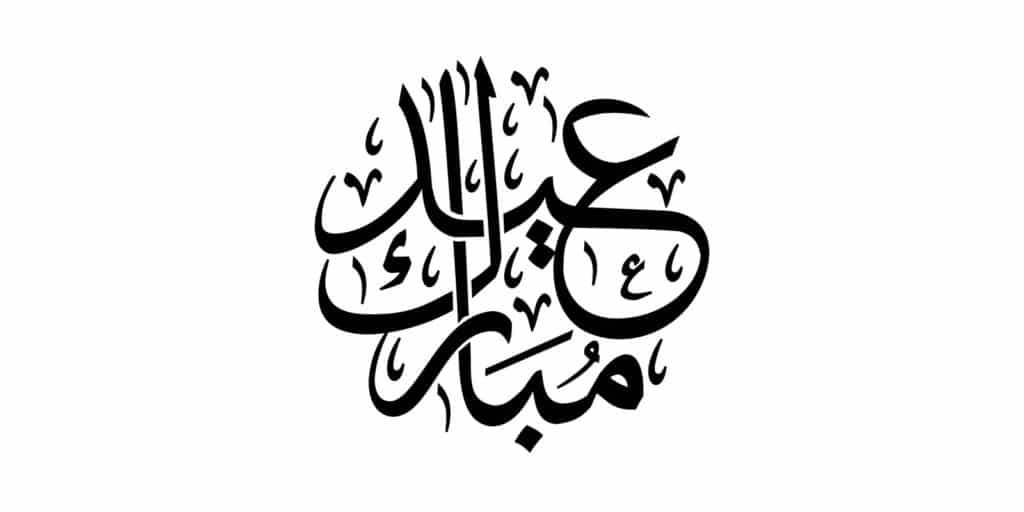
We use the simple script “Eid Mubarak” (Blessed Holiday) for this Eid.