

Los Pleneros de la 21 are a New York Puerto Rican group of bomba and plena teaching artists, based in “El Barrio” East Harlem. They are Grammy nominated, National Endowment of the Arts fellows.
The group usually celebrates Las Fiestas de Cruz in May, and a parranda, and a Gran Fiesta Navideña during the holidays. ¡WEPA, WEPA, WEPA!
A little advice. If you are lonely in New York City, study bomba or plena with Los Pleneros de la 21. You will find yourself in the most loving community. Welcome to Puerto Rico!
Los Pleneros de la 21 in New York City
Taino Towers “El Barrio,” East Harlem
Los Pleneros de la 21 celebrate La Gran Fiesta Navideña; in the Crystal Ballroom at Taíno Towers in “El Barrio” East Harlem, Manhattan, on Sunday, December 14, 2025, from 2:30-9:30pm. From $26, $166 for a table. 🇵🇷
New York Venues
These are some of the places where Los Pleneros de la 21 play:
- Carnegie Hall in Midtown, Manhattan
- El Museo del Barrio in “El Barrio” East Harlem
- Julia de Burgos Cultural Center in “El Barrio” East Harlem
- Hostos Center at Hostos College in Mott Haven, The Bronx
- Pregones/PRTT in Concourse, The Bronx
- Taíno Towers in “El Barrio” East Harlem
Los Pleneros de la 21
The group was founded in 1983 by NEA Fellow “Juango” Juan J. Gutiérrez and Master Plenero Marcial Reyes Arvelo. Gutiérrez still leads the group.
The group’s name comes from the old trolley stop 21 in Santurce, San Juan, Puerto Rico. That stop was once a neighborhood of famous pleneros.
They are NEA – National Endowment of the Arts fellows. “Para Todos Ustedes” was Grammy-nominated for “Best Traditional World Music Album” in 2005.
Bomba and Plena
The group’s name refers to plena, but they are often photographed singing, drumming, and dancing bomba. Don’t be confused. Bomba and plena are not the same thing, though in Puerto Rico, they come from the same neighborhoods where African Diasporic Culture remains strong. Puerto Rican folkloric groups usually do both arts. That’s why you see “bomba y plena” together.
- Bomba uses a barril, a barrel drum that used to be made from rum barrels.
- Plena uses the pandereta, a hand drum like a tambourine without jingles, which originally came from the Arab world.
The rhythms and dances are different too. Bomba and plena influences are some of the things that makes New York salsa different from its son Cubano roots. Many people associate bomba dancing with the striking woman’s movements and dress work. But men dance bomba too, and sometimes are even more interesting. Try it. It’s easy and fun.
Las Fiestas de Cruz
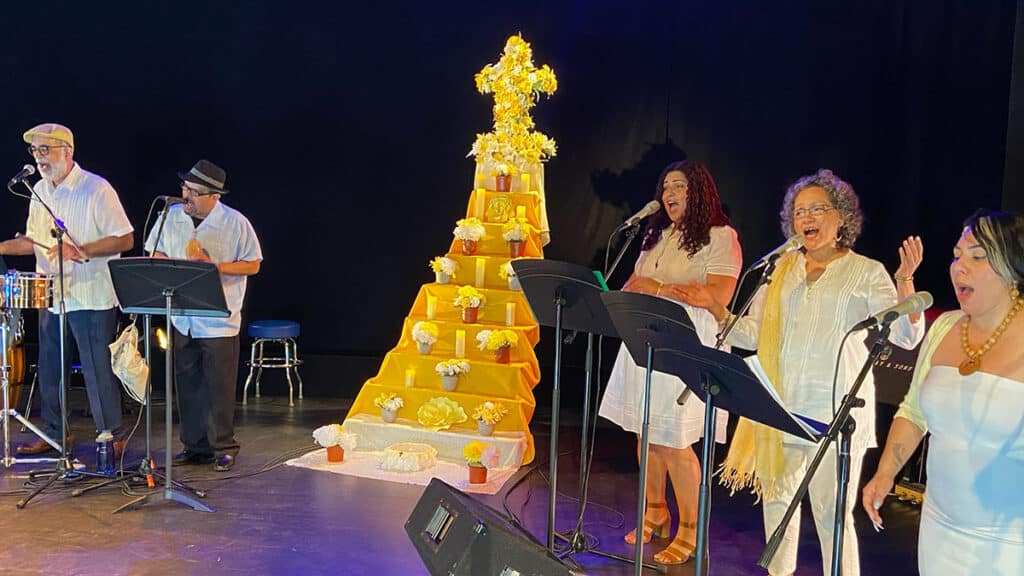
Las Fiestas de Cruz is an old Puerto Rican tradition of chanting rosaries that we inherited from the Spanish Colonial Era.
We don’t do it quite the way Spaniards would because we’re Puerto Rican, and its not so religious anymore. It’s a community gathering. This is really a Taíno areíto (Indigenous Puerto Rican community gathering) with everything that goes with that. The tribe lives on in the community.
Puerto Rico sits on the boundary of the Caribbean and North American tectonic plates. A great earthquake struck the northern side of the island on May 3, 1787. It is believed to have been the biggest earthquake in Puerto Rico’s recorded history.
Churches, the community centers of the day, were damaged across the north and west coasts in Arecibo, Bayamón, Toa Baja and Mayagüez (where bomba originated). The people found pieces of crosses from the broken churches and in Latin religious tradition, began to pray rosaries.
Today, there are usually 19 traditional songs which are sung in African call and response.
On the island, there are usually Las Fiestas de Cruz celebrations on Calle Tanca in Old San Juan (above the stairway to La Perla) and in Villa Palmeras, Santurce’s immigrant neighborhood (The Bronx of Santurce).
Puerto Rican culture lives forever. 🇵🇷